


Key report findings
The fentanyl epidemic has long been regarded as a uniquely American tragedy. But as this report from TRM Labs shows, it is one node in a vast network that encompasses most of the world’s trade in illicit synthetic drugs.
The factories that produce the world’s fentanyl precursors also manufacture and sell the key ingredients for almost every other common synthetic drug sold in European and Asian markets. A significant number of these factories are located in China.
Cryptocurrency is an important aspect of the international precursor trade. Of the more than 120 Chinese precursor manufacturers studied by TRM for this report, spanning 26 cities and 16 provinces, 97% offered payment in cryptocurrencies.
Here are the key findings from our research:
- Chinese precursor manufacturers received over USD 26 million in cryptocurrency in 2023. This is in addition to dollar-denominated sales, which cannot be traced using blockchain intelligence. 11 manufacturers accounted for just over 70% of all crypto-denominated sales of drug precursors tracked by TRM Labs.
- The amount of cryptocurrency deposited into wallets linked to Chinese precursor manufacturers increased by over 600% from 2022 to 2023, and more than doubled in the first four months of 2024, compared to the same period in 2023.
- Around 60% of cryptocurrency payments to Chinese precursor manufacturers to date were made on the Bitcoin blockchain, followed by the TRON blockchain at approximately 30% and the Ethereum blockchain at about 6%.
- Starting at a low base of just under USD 60,000 in volume in 2022, the value of deposits made to Chinese precursor manufacturers on the Ethereum blockchain grew by nearly 2,000% by the end of 2023. Transactions on Bitcoin grew by over 600% during the same period, while transactions on the TRON blockchain posted a near 500% growth.
- While precursor manufacturers often adopt a veneer of legitimacy, at least 20 of those tracked by TRM Labs were found to have direct on-chain links to darknet markets (DNMs) and online vendors of banned and controlled substances. To date, TRM has traced at least USD 1.3 million worth of cryptocurrency sent directly from various illicit drug marketplaces and vendor shops to Chinese precursor manufacturers.
- Nearly two-thirds of fentanyl precursor manufacturers studied by TRM also advertised at least one other precursor for drugs such as mephedrone, MDMA, and spice. Almost 60% also marketed nitazenes and xylazine, a strong veterinary sedative sometimes mixed with fentanyl.
- Canada, the Netherlands, Australia, Germany, and the US were the top five markets targeted by advertisements from Chinese precursor manufacturers.
- MDMA precursors were the most popular products marketed to Canada, Western European countries, and Australia. The largest number of ads targeting Russia and its neighboring countries marketed mephedrone precursors, while those aimed at the US and Mexico offered fentanyl precursors.
{{premium-content_chapter-divider}}
A global epidemic, made in China
Chinese companies produced almost all the precursors used to manufacture the fentanyl that killed over 100,000 Americans in 2023 alone. Yet while fentanyl use has been largely confined to North America, it is part of a truly global drug epidemic.
That’s because many of the same factories that make the world’s fentanyl precursorsalso manufacture and sell the key ingredients for almost every other common synthetic drug sold on European and Asian markets. These include nitazenes, mephedrone, spice, MDMA, and amphetamines.
- Nitazenes are powerful synthetic opioids that are becoming increasingly popular in the UK and the Baltic States
- Mephedrone is a synthetic stimulant drug abused in Russia and its neighboring countries
- Spice is a synthetic cannabinoid used in the UK
A significant number of precursor manufacturers are located in central and eastern China, with a particular concentration in Wuhan (Hubei province), followed by Shijiazhuang City (Hebei province). Over the past decade, many precursors have been designated as controlled substances, both by the United Nations Commission on Narcotic Drugs and the US Department of Justice’s Drug Enforcement Administration (DEA).
However, despite the bans, some Chinese manufacturers tracked by TRM Labs continue to advertise such precursors, including 4-(Phenylamino)piperidine (CAS 125541-22-2) and N-Boc-4-piperidone (CAS 79099-07-3). Other manufacturers have moved to abandon the production and sale of banned substances in favor of other precursors and nitazenes that have not yet been banned.
Though research suggests that precursor sales are still overwhelmingly conducted using traditional payment methods, cryptocurrency is increasingly becoming central to the international precursor trade. TRM Labs found that the amount of crypto-denominated funds deposited into wallets linked to Chinese precursor manufacturers more than doubled in the first four months of 2024 alone, compared to the same period in 2023.
This report reveals evidence of cryptocurrency use by Chinese precursor manufacturers and the international markets they target.
Crypto use by Chinese precursor manufacturers soared by over 600% since 2022
Of the more than 120 Chinese precursor manufacturers studied by TRM — spanning 26 cities and 16 provinces — 97% offered payment in cryptocurrencies. Most also accepted a range of other payment methods, including PayPal, MoneyGram, Western Union, and bank transfer.
The amount of cryptocurrency deposited into wallets linked to Chinese precursor manufacturers increased by over 600% from 2022 to 2023, and more than doubled in the first four months of 2024 compared to the same period in 2023.
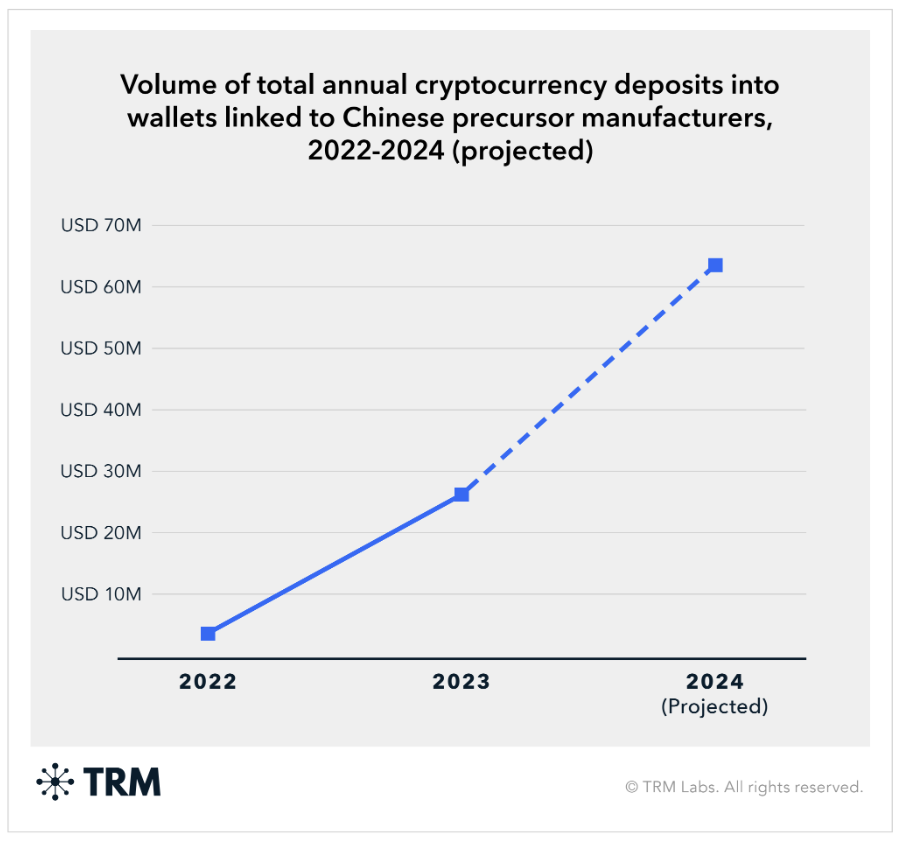
In total, the Chinese precursor manufacturers reviewed received over USD 26 million in cryptocurrency in 2023. 11 of the manufacturers accounted for just over 70% of all crypto-denominated sales of drug precursors tracked by TRM Labs.

Not all manufacturers advertised their acceptance of cryptocurrency, possibly owing to increased vigilance from US authorities. One of the precursor manufacturers included in this study, Hanhong Pharmaceutical, has been sanctioned by the US Treasury’s Office of Foreign Assets Controls (OFAC). And five others — Anhui Rencheng, Anhui Ruihan, Xiamen Wonderful, Hebei Shenghao, and Lihe Pharmaceutical Technology — were indicted by the US Department of Justice (DoJ), but not sanctioned by OFAC.
Crypto funds sent to Chinese precursor manufacturers primarily come from unhosted wallets, cryptocurrency exchanges, and payment services; the manufacturers’ wallets are most commonly hosted at exchanges. The TRM graph below shows funds sent to a precursor manufacturer from a mix of exchanges and payment services. These funds are then routed onward to another exchange, potentially with a view to be off-ramped into fiat currency.

Several of the manufacturers observed in this study appear to share their financial infrastructure. For example, two apparently separate manufacturers (one in Shanghai and the other in Shenzen) appear to share an account at a major cryptocurrency exchange. In another instance, a precursor manufacturer based in China’s central Hubei province and one based in Hebei, near Beijing, both appeared to share an account at a mainstream exchange.
Bitcoin remains the blockchain of choice, but Ethereum grew fastest
Approximately 60% of cryptocurrency payment volume to Chinese precursor manufacturers to date has occurred on the Bitcoin blockchain, followed by the TRON blockchain at around 30% and the Ethereum blockchain at about 6%.

Starting at a low base of just under USD 60,000 in 2022, the use of the Ethereum blockchain by Chinese precursors manufacturers grew by nearly 2,000% by the end of 2023. Transactions on Bitcoin (BTC) grew by over 600% over the same period. For transactions on the TRON blockchain, growth was just shy of 500%.

Precursor manufacturers sell to darknet markets and online illicit drugs vendors
The fact that some synthetic drug precursors also have legal, conventional applications (e.g. cosmetics and cleaning products) can give manufacturers plausible deniability about their use in the illicit drug trade. Many precursor manufacturers have polished websites — complete with detailed photographs and descriptions of their products — and offer express delivery by sea, air, and road with established couriers.
However, TRM Labs has identified at least 20 Chinese precursor manufacturers that have been directly linked to online vendors of banned and controlled substances and DNMs. Most of the approximately USD 26 million in crypto received by the precursor vendors profiled in this report came directly from a range of unhosted wallets, cryptocurrency exchanges, and payment services. However, TRM identified at least USD 1.3 million worth of crypto-denominated funds as coming directly from various illicit drug marketplaces and vendor shops. This suggests that these marketplaces and vendor shops are buying precursors in order to produce illicit drugs sold on their platforms.
{{26-beyond-fentanyl-report-callout-1}}
Some precursor manufacturers hint at their illicit activity by referring to “discrete packaging,” a euphemism for the use of falsified labeling to evade customs checks. The screenshot below shows one precursor manufacturer even offering to “change [the] chemical name on the parcel.”

Cryptocurrency ATMs based in the US were also found to have sent more than USD 170,000 directly to Chinese precursor vendors in 2023. Although crypto ATMs are legal in the US and are widely used for everyday transactions, fewer than 10% of services impose comprehensive Know Your Customer (KYC) checks. A lack of KYC could render a service more attractive to criminals who may seek to use it without being easily identified.
This cryptocurrency ATM exposure may indicate that buyers physically located in the US may be trying to obfuscate their identities. While the identified volume is relatively small, these transactions provide law enforcement with actionable leads for identifying fentanyl manufacturers or precursor resellers based in the US.
Beyond fentanyl, precursor manufacturers target multiple geographies with varied drug offerings
Nearly two-thirds of fentanyl precursor manufacturers studied by TRM also advertised at least one other precursor for drugs such as mephedrone, MDMA, and spice. Almost 60% also marketed nitazenes and xylazine, a strong veterinary sedative that is sometimes mixed with fentanyl.
Different drug precursors are marketed to specific countries. The top five markets targeted by advertisements from Chinese precursor manufacturers were Canada, the Netherlands, Australia, Germany, and the US.

MDMA precursors benzyl methyl ketone (BMK) and Piperonylmethylketone (PMK) were the most popular products marketed to Canada, Western Europe, and Australia. Ads targeting Russia and its neighboring countries marketed mephedrone precursors, while those aimed at the US and Mexico offered fentanyl precursors.
{{premium-content_chapter-divider}}
The increasing use of cryptocurrency in the precursor trade creates new avenues for law enforcement disruption
Our findings show that the manufacturing and sales networks underpinning the fentanyl crisis also serve as the backbone for the international trade in MDMA, LSD, nitazenes, spice, and methamphetamines, the leading categories of illicit synthetic drugs across European and Asian markets.
The global precursor trade’s increasing reliance on cryptocurrency presents a unique opportunity for authorities to leverage blockchain intelligence. By tracing cryptocurrency transactions, law enforcement can map the financial infrastructure underpinning these operations, revealing connections between actors and identifying key financial nodes within the ecosystem. This detailed mapping illuminates the flow of funds from buyers to precursor manufacturers and helps pinpoint the individuals and organizations behind these markets. Equipped with these blockchain-based insights, law enforcement gains a powerful toolset to disrupt the synthetic drug trade and weaken global trafficking networks.
{{premium-content_chapter-divider}}
Frequently asked questions (FAQs)
1. Why are synthetic drug precursors a global issue?
Many of the same suppliers that produce fentanyl precursors also manufacture ingredients for other synthetic drugs widely sold in Europe, Asia, and North America.
2. How commonly do precursor manufacturers accept cryptocurrency?
Of the more than 120 Chinese precursor manufacturers studied by TRM for this report, spanning 26 cities and 16 provinces, 97% offered payment in cryptocurrencies.
3. How much cryptocurrency flowed to precursor manufacturers in 2023?
Wallets linked to Chinese precursor manufacturers received more than USD 26 million in cryptocurrency during 2023 alone.
4. Which blockchains are most commonly used in precursor transactions?
Most payments occurred on the Bitcoin blockchain, followed by TRON, with Ethereum accounting for a smaller but rapidly growing share.
5. Why is Ethereum’s growth notable in this market?
Although Ethereum started from a lower base, transaction volumes linked to precursor manufacturers grew by nearly 2,000% from 2022 to 2023.
6. Are precursor manufacturers connected to illicit drug markets?
TRM identified direct on-chain links between some manufacturers and darknet markets and online vendors selling banned or controlled substances.
7. Which countries are most often targeted by precursor advertisements?
Top target markets include Canada, the Netherlands, Australia, Germany, and the United States, with different drugs marketed to different regions.
8. How does cryptocurrency complicate or enable precursor trade enforcement?
Crypto enables cross-border payments at scale, but it also creates traceable transaction data that authorities can analyze using blockchain intelligence.
{{premium-content_chapter-divider}}
About TRM Labs
TRM Labs provides blockchain analytics solutions to help law enforcement and national security agencies, financial institutions, and cryptocurrency businesses detect, investigate, and disrupt crypto-related fraud and financial crime. TRM’s blockchain intelligence platform includes solutions to trace the source and destination of funds, identify illicit activity, build cases, and construct an operating picture of threats. TRM is trusted by leading agencies and businesses worldwide who rely on TRM to enable a safer, more secure crypto ecosystem.
TRM is based in San Francisco, CA, and is hiring across engineering, product, sales, and data science. To learn more, visit www.trmlabs.com.


