


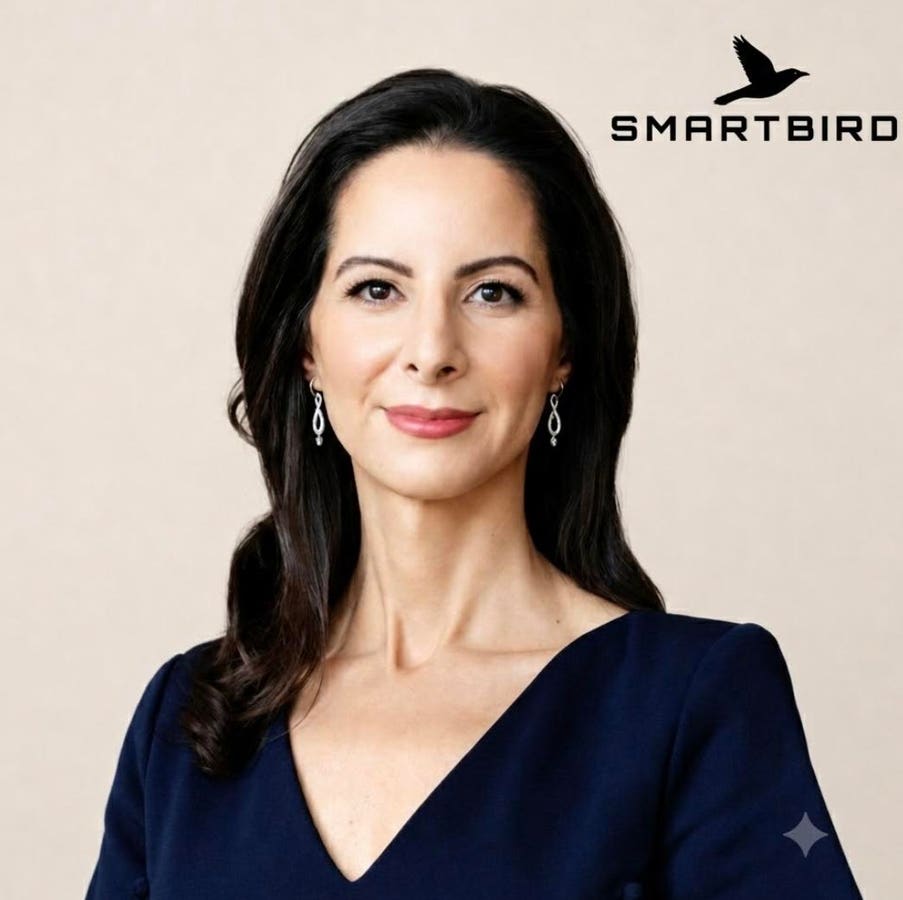
On June 17, the company formerly called Allbirds, Inc. (NASDAQ: BIRD) closed the sale of its Allbirds footwear brand and assets, changed its legal name to Smartbird, and reintroduced itself as an AI infrastructure provider.
Smartbird
Smartbird, Inc. just pulled off one of the more striking reinventions on the public markets, trading wool sneakers for GPU clusters. And yes, they used to be Allbirds, my favorite sneaker company. When the AI pivot first broke, BIRD spiked nearly 600% in a single session, market cap leaping from roughly $22 million toward $150 million on a press release alone.
In chatting with the new SmartBird CEO Nadia Carlsten, she told me “How many people have the chance to actually get a company off the ground with access to over $100 million on day one? Many founders would kill for the opportunity to start with what Smartbird has: access to $100 million in capital, a clear strategy that leverages my track record, and the mandate to make it happen. Enduring companies are built by solving real problems, and that’s exactly what we’re setting out to do.”
Here are five things to know about the company, its new CEO, and the case both bulls and skeptics are making.
1. Allbirds Is Now Smartbird.AI And The Shoes Are Gone
On June 17, the company formerly called Allbirds, Inc. (NASDAQ: BIRD) closed the sale of its Allbirds footwear brand and assets, changed its legal name to Smartbird, and reintroduced itself as an AI infrastructure provider.
The stock keeps trading under the ticker BIRD. Nadia Carlsten steps in as president and chief executive officer and joins the board, independent director Lily Yan Hughes becomes board chair, and Annie Mitchell stays on as chief financial officer.
2. The New CEO Is A Deep AI Infrastructure Operator
Carlsten arrives with one of the more technical résumés in the sector. She most recently led DCAI, an AI infrastructure company where she launched a sovereign AI supercomputer with NVIDIA.
Earlier she served as vice president of product at Google spin-off SandboxAQ and led product for AWS’s quantum computing service during her time at Amazon Web Services.
Nadia most recently led DCAI, an AI infrastructure company where she launched a sovereign AI supercomputer with NVIDIA. (Photo by Jonathan Raa/NurPhoto via Getty Images)
NurPhoto via Getty Images
She sits on the World Economic Forum’s Global Future Council on Next Generation Computing, holds dual bachelor’s degrees in chemistry and physics from the University of Virginia, and earned a doctorate in engineering from the University of California, Berkeley.
“Nadia is the perfect leader for Smartbird,” said Lily Yan Hughes, Smartbird’s board chair. “She has built AI infrastructure from the ground up and sold it to top enterprises. She identified the same market gap we did: large organizations that need dedicated AI infrastructure but don’t want to be infrastructure operators. That combination of hands-on experience and market insight is why we are thrilled.”
3. Smartbird Is Chasing The AI Enterprise Mid-Market
Carlsten’s thesis is that hyperscalers and neoclouds crowd around two extremes, the frontier labs at the top and individual developers at the bottom, leaving a fast-growing middle underserved.
Smartbird aims at that middle: pharmaceutical companies, financial services firms, and public sector agencies that are scaling AI yet cannot rely on shared cloud environments because of compliance, security, or sovereignty requirements. These organizations want dedicated infrastructure, and they have no appetite for becoming infrastructure operators themselves.
4. Smartbird Sells AI Infrastructure As A Strategic Capability
Smartbird describes itself as the managed private cloud for AI. It builds a dedicated, single-tenant cluster to each customer’s specifications and runs the full lifecycle from procurement through deployment, operations, and hardware refreshes.
The value in AI has moved past the foundation models that captivated investors and now concentrates in compute, networking, orchestration, and deployment, the layer that turns a model into business results. A model on its own creates no value. As we saw with the SpaceX acquisition of Cursor, AI is being valued based on its usage.
Smartbird works across multiple compute, networking, and storage vendors to build the right stack for each requirement, giving customers predictable economics, reduced lock-in, and room to evolve.
Flexibility is the fix for the most common enterprise mistake, then paying for it later, once AI workloads scale and the bill comes due.
5. The Next 12 Months Are Smartbird’s AI Proof Points
Over the coming year, Carlsten expects to assemble a core team, deliver Smartbird’s first GPU clusters, and begin generating revenue, with prospective customers already in discussions and first deployments now in design.
She is candid about the scale of the pivot and confident it can fade into the company’s success. “Silicon Valley is full of examples of dramatic company pivots, and our goal is to be so successful as an AI infrastructure company over the next few years that few will even remember how this started,” Carlsten said. “Who remembers that YouTube used to be a dating site, or that CoreWeave started in crypto mining?”
Smartbird.AI Will Have To Prove The Skeptics Wrong
The bear case is just as easy to make. Skeptics question whether the underserved middle is real, since hyperscalers now push sovereign regions and dedicated capacity down-market while neoclouds and hardware vendors like Dell and HPE sell their own managed AI infrastructure.
By that read, the mid-market is one of the sector’s most crowded lanes. The bears also flag capital intensity: GPU clusters cost a fortune, and a company that just sold a sneaker brand has to fund them while rivals deploy billions.
DCAI and Nadia Carlsten receiving a DGX bezel signed by Jensen Huang, personally dedicated to DCAI in recognition of what our team has built since Gefion.
Nadia Carlsten
The team is being built from scratch on a repurposed public shell, so execution risk runs high. Bulls counter that the operator discipline and a vendor-neutral stack become the moat, and that mid-market buyers will pay for control they cannot get from a shared cloud.
For a company that started in sustainable sneakers, the next year decides whether Smartbird becomes the infrastructure backbone its mid-market customers build on.


