


While Bitcoin and Ethereum continue to shape the broader crypto landscape, Solana has established itself as a major blockchain network in its own right. Known for its high throughput, low transaction costs, and growing developer ecosystem, Solana has become an important hub for Web3 innovation. Its network supports a wide range of applications, spanning decentralised finance (DeFi), NFT marketplaces, gaming, and other on-chain use cases. In 2026, growing adoption among retail users, developers, and institutional participants has further strengthened Solana’s position as one of the leading high-performance Layer 1 blockchains. This growing ecosystem has also increased interest in Solana price predictions, as investors and market participants evaluate its long-term potential in an increasingly competitive blockchain landscape. Any Solana price prediction ultimately depends on several factors, including network adoption, developer activity, capital inflows, ecosystem growth, and the blockchain’s ability to maintain its performance as demand increases.
Looking ahead, Solana’s next phase of growth will depend on how effectively it can build on its existing strengths while addressing the challenges that come with a rapidly expanding network. Improving network reliability, maintaining consistent performance, and strengthening user confidence will remain important priorities. At the same time, Solana will need to navigate evolving regulations and increasing competition from other Layer 1 and Layer 2 networks. If Solana can sustain ecosystem growth while improving resilience and reliability, it could strengthen its role as a key infrastructure layer for the decentralised economy. However, its long-term trajectory will ultimately depend on how well it balances performance, scalability, innovation, and network stability in an increasingly competitive crypto market.
What is Solana and Why Does it Matter?
Since its mainnet launch in 2020, Solana has evolved into one of the most widely recognised Layer 1 blockchains, built to address the scalability and performance limitations faced by earlier blockchain networks. Its architecture is designed to process transactions quickly and at relatively low costs, making the network suitable for applications that require frequent on-chain activity. This performance has helped Solana attract a growing community of developers building across DeFi, gaming, NFTs, payments, and other areas of Web3.
At the centre of Solana’s architecture is Proof of History (PoH), a mechanism that creates a verifiable record of when events occur on the blockchain. Rather than relying on validators to establish the timing of every transaction through communication alone, PoH provides a common reference for ordering events. Working alongside Solana’s broader consensus and execution architecture, this contributes to the network’s high throughput and fast transaction confirmation times.
SOL is the native token that powers the Solana ecosystem. It is used to pay network transaction fees and can be staked by token holders to participate in securing the blockchain. SOL also serves as the primary asset within Solana’s expanding ecosystem of decentralised applications and protocols. As activity on the network grows, the utility of SOL remains closely linked to the adoption, usage, and continued development of the Solana blockchain.
Solana (SOL) Technical Indicators
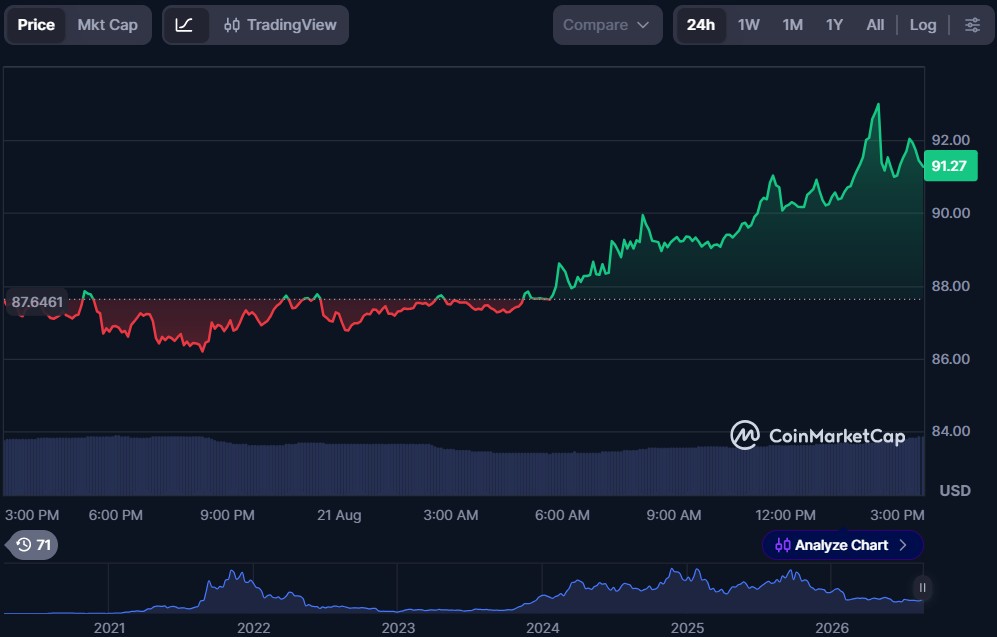
| Current Price | $91.28 |
| Market Capitalization | $53.23 billion |
| 24-Hour Volume | $6.09 billion |
| 50-Day SMA (1 Day) | $76.84 |
| 100-Day SMA (1 Day) | $76.30 |
| 200-Day SMA (1 Day) | $81.14 |
| 14-Day Relative Strength Index (1 Day) | 81.13 |
| All-Time High | $293.31 |
| Circulating Supply | 583.17 million |
Key Factors That Influence Solana Price Predictions
Supply and Demand Dynamics
At its core, the value of Solana is driven by supply and demand. Factors such as token issuance, staking participation, and circulating supply influence how much SOL is available in the market. On the demand side, increased usage across DeFi, NFTs, and gaming ecosystems can drive higher buying pressure. These dynamics form a fundamental base for Solana price predictions, as any imbalance between supply and demand can lead to significant price movements.
Network Performance and Ecosystem Growth
Solana’s reputation is closely tied to its high-speed, low-cost infrastructure. Its ability to process thousands of transactions per second has made it attractive for developers and users alike. As more projects launch and the ecosystem expands, network activity tends to rise—strengthening its value proposition. A growing ecosystem, combined with consistent performance improvements, plays a key role in shaping any price prediction for Solana.
Institutional Adoption
Institutional interest can act as a major catalyst for Solana’s growth. From venture capital investments in Solana-based projects to institutional participation in staking and infrastructure, increased involvement adds liquidity and credibility. As institutions continue to explore scalable blockchain solutions, their engagement is often reflected in more optimistic Solana price predictions.
Global Macroeconomic Conditions
Like all crypto assets, Solana is influenced by broader economic trends. Interest rates, inflation, global liquidity, and regulatory developments can impact investor sentiment and capital flows. In favorable macro conditions, risk assets like SOL often see increased demand, while tighter financial environments can dampen momentum—making macro factors essential in any price prediction for Solana.
Role of Technical Analysis in Solana Price Forecasts
Technical analysis helps traders and investors interpret price patterns and market behavior, offering structured insights that complement fundamental analysis in forming Solana price predictions.
Moving Averages
Moving averages smooth out price fluctuations to identify overall trends. Indicators like the 50-day and 200-day moving averages are commonly used to assess whether Solana is in a bullish or bearish phase. Crossovers between these averages often serve as signals in refining a price prediction for Solana.
Relative Strength Index (RSI)
The RSI measures momentum by evaluating the speed and magnitude of price changes. Values above 70 suggest overbought conditions, while values below 30 indicate oversold territory. This helps traders anticipate potential reversals and incorporate them into Solana price predictions.
MACD Indicator
The Moving Average Convergence Divergence (MACD) tracks momentum and trend strength by comparing two moving averages. It is widely used to identify potential buy or sell signals, making it a valuable tool when building a price prediction for Solana.
Solana Price Prediction Models Explained
On-Chain Analysis Models
On-chain analysis examines blockchain data such as transaction volume, active addresses, staking activity, and validator participation. These metrics provide direct insight into network health and usage. Strong on-chain activity often signals growing adoption, which can positively influence Solana price predictions.
Market Sentiment Indicators
Market sentiment reflects the overall mood of investors and traders. Social media trends, news developments, funding rates, and sentiment indices all contribute to understanding how the market perceives Solana. Positive sentiment can drive rapid price increases, while negative sentiment may trigger corrections—making it a key input in any price prediction for Solana.
Network Activity Metrics
Network activity metrics offer a real-time view of how actively Solana is being used. Indicators such as transaction count, daily active users, and ecosystem engagement highlight the level of demand for the network. Rising activity typically signals stronger adoption and utility, supporting more optimistic Solana price predictions over time.
Also Read: White House Crypto Meeting: Key Takeaways
Price Predictions
2026
For 2026, Solana is projected to trade around the $300 level, reflecting steady growth backed by ecosystem expansion.
2027
Looking ahead to 2027, Solana price predictions suggest a potential move beyond $450, indicating increasing market confidence and adoption.
2028
By 2028, the price prediction for Solana points toward a climb closer to $750, supported by continued network usage and developer activity.
2029
Moving into 2029, Solana is anticipated to surpass the $1,300 mark, highlighting a strong upward trajectory in long-term forecasts.
2030
By 2030, Solana could approach the $2,000 level, underscoring optimistic sentiment around its role in the future of decentralized infrastructure.
Risks and Uncertainties in Solana Price Predictions
While Solana price predictions can offer useful directional insights, they are subject to a high degree of uncertainty. The crypto market remains volatile, and factors such as regulatory changes, shifts in investor sentiment, and macroeconomic developments can quickly alter price trajectories. For Solana in particular, concerns around network stability and past outages continue to be closely watched by market participants. Additionally, increasing competition from other Layer 1 and Layer 2 solutions can influence its market position. As a result, any price prediction for Solana should be viewed as a scenario-based outlook rather than a guaranteed forecast.
How Investors Use Price Predictions in Crypto Strategies
Investors often rely on Solana price predictions as a reference point when building their crypto strategies. These forecasts help in identifying potential entry and exit levels, planning long-term allocations, and managing overall portfolio risk. Some investors use predictions to support systematic approaches like dollar-cost averaging (DCA), while others incorporate them into short-term trading strategies based on anticipated price movements. By combining these insights with technical and fundamental analysis, investors aim to make more informed decisions rather than relying purely on speculation.
Key Considerations Before Relying on Solana Price Forecasts
Before acting on any price prediction for Solana, it is important to consider the broader context in which these forecasts are made. No single model can account for all variables, so it is essential to evaluate multiple factors such as on-chain data, technical indicators, and market sentiment. Investors should also assess their own risk tolerance, investment horizon, and financial goals. Ultimately, Solana price predictions are best used as guiding tools—helping users navigate an evolving market—rather than definitive answers to investment decisions.
Is Solana a Good Investment?
Solana has carved out a distinct position in the blockchain ecosystem by combining high transaction throughput with a focus on keeping costs low. Its strong performance and growing developer activity have positioned it as a leading alternative to Ethereum, particularly for applications that require fast and frequent on-chain transactions. This has contributed to Solana’s growing adoption across DeFi, gaming, NFTs, and other Web3 use cases.
A defining characteristic of Solana is its monolithic blockchain architecture, where core functions such as execution, consensus, and data processing operate within the same network layer. Instead of depending heavily on sharding, sidechains, or layer-2 networks to scale activity, Solana aims to increase capacity through improvements to its underlying infrastructure. This approach can simplify the network’s architecture while enabling applications to interact directly with the base layer.
Solana has also experienced periods of network congestion and outages, highlighting the challenges of maintaining reliability as blockchain usage scales. Continued infrastructure upgrades, client improvements, and network optimisation remain important to strengthening its stability. How effectively Solana addresses these challenges will play a key role in supporting the network’s long-term growth and adoption.
Also Read: Ethereum Price Prediction
Should I Invest in SOL?
For investors looking beyond Ethereum, Solana remains a compelling alternative. Continued network upgrades and infrastructure improvements have helped enhance its performance and address some of the technical challenges it faced in its earlier years.
While short-term price movements can remain unpredictable, Solana’s long-term potential continues to attract attention. Its growing ecosystem, developer activity, and expanding real-world use cases could play an important role in shaping its future.
Also Read: Top 10 Cryptos to Invest in 2026
Unravel everything that you need for your crypto journey via ZebPay blogs. Get started today and join 6 million+ registered users on ZebPay!
FAQs on Solana Price Prediction
What factors influence Solana price predictions?
Solana price predictions are influenced by a combination of factors, including supply and demand dynamics, network performance, ecosystem growth, institutional participation, and overall market sentiment. Broader elements such as regulatory developments and macroeconomic conditions also play a key role in shaping the future price outlook of Solana.
How reliable are Solana price prediction models?
No prediction model is entirely reliable, especially in a highly volatile market like crypto. While models based on historical data, on-chain metrics, and technical indicators can provide valuable insights, they should be treated as directional tools rather than exact forecasts.
How does ecosystem growth affect Solana price forecasts?
Ecosystem growth is a major driver of Solana’s value. As more decentralized applications, users, and developers join the network, demand for SOL tends to increase. This rising adoption often strengthens Solana price predictions, as it reflects expanding utility and real-world usage.
How do analysts use technical indicators to forecast Solana prices?
Analysts use tools such as moving averages, RSI, and MACD to study price trends, momentum, and potential reversal points. These indicators help structure Solana price predictions by offering data-driven insights into market behavior.
Can institutional adoption impact Solana’s future price?
Yes, institutional adoption can significantly influence Solana’s price. Increased participation from funds, corporations, and large investors brings liquidity and long-term capital, often contributing to more optimistic price prediction for Solana.
What risks should investors consider when relying on Solana price predictions?
Investors should consider risks such as market volatility, regulatory uncertainty, network reliability concerns, and competitive pressures from other blockchain platforms. These factors can impact the accuracy of Solana price predictions and lead to unexpected price movements.
How do macroeconomic trends affect Solana price forecasts?
Macroeconomic conditions like inflation, interest rates, and global liquidity influence investor appetite for risk assets. These trends directly affect Solana price predictions, as they determine how capital flows into or out of the crypto market.
Should investors rely solely on Solana price predictions when making decisions?
No, relying solely on predictions can be risky. Investors should combine Solana price predictions with fundamental analysis, technical insights, and their own financial goals to make well-informed decisions in a dynamic and evolving mark.
Disclaimer:
Crypto products and NFTs are unregulated and can be highly risky. There may be no regulatory recourse for any loss from such transactions. Each investor must do his/her own research or seek independent advice if necessary before initiating any transactions in crypto products and NFTs. The views, thoughts, and opinions expressed in the article belong solely to the author, and not to ZebPay or the author’s employer or other groups or individuals. ZebPay shall not be held liable for any acts or omissions, or losses incurred by the investors. ZebPay has not received any compensation in cash or kind for the above article and the article is provided “as is”, with no guarantee of completeness, accuracy, timeliness or of the results obtained from the use of this information.


